


The Daily Outside Sunday: Coffee with the Birds, Plants Gone Wild
Sunday rewards the people who pay attention. A seabird becomes a storyteller, a zoo becomes a botanical garden, a run becomes a community, a single plant becomes tomorrow’s garden, and a mountain spends the day revealing itself one lesson at a time.
Where Sunday morning runs beside the Salish Sea
Tacoma Run Club Sunday Run
Sunday, Aug. 2, 2026 • 7:30 a.m.
Meet outside Anthem Coffee at Point Ruston
5005 Main St., Suite 105, Tacoma
Free • Approximately 3–5 miles
All paces welcome
Before the waterfront fills with strollers, bicycles, and the pleasant civic sprawl of a summer Sunday, Tacoma Run Club gathers outside Anthem Coffee for three to five miles beside Commencement Bay. The route follows Ruston Way’s paved waterfront path, where Puget Sound keeps pace on one side and Mount Rainier occasionally materializes on the horizon like an overqualified course marshal. Participants choose their own distance and speed, making the weekly outing equally welcoming to first-timers, experienced racers, stroller parents, walkers, and dog owners. There are no pace requirements and no insistence that anyone turn coffee into a competitive sport.
Tacoma Run Club grew from two friends who began running together in 2018 during a period when both were trying to change the direction of their lives. What started as an uncomfortable personal challenge gradually became a Sunday ritual shared by a much larger community. That origin still shapes the group’s philosophy: progress matters more than speed, showing up matters more than athletic credentials, and difficult things tend to become more manageable when someone is moving beside you. Today, the waterfront gathering regularly draws runners from across Tacoma while remaining open and informal enough for a newcomer to join without first acquiring an advanced vocabulary of splits, thresholds, and carbon-plated footwear.
Meet outside Anthem Coffee and arrive about 15 minutes early; the club notes that parking is free before the run. The outing proceeds rain or shine, because Pacific Northwest weather has apparently been admitted as a permanent member. Wear comfortable shoes, bring water as needed, keep dogs leashed and strollers under control along the shared path, and remain alert for walkers and cyclists. Afterward, coffee provides the natural finish line, along with the more lasting reward of beginning Sunday beside the water with people who understand that community can be built one ordinary mile at a time.
More info: Tacoma Run Club
Where a small seabird tells the story of an entire sea
Coffee with the Birds: Pigeon Guillemots
Sunday, Aug. 2, 2026 • 9–11 a.m.
Meet at the Titlow Park Picnic Shelter
8425 Sixth Ave., Tacoma
Free • Registration required
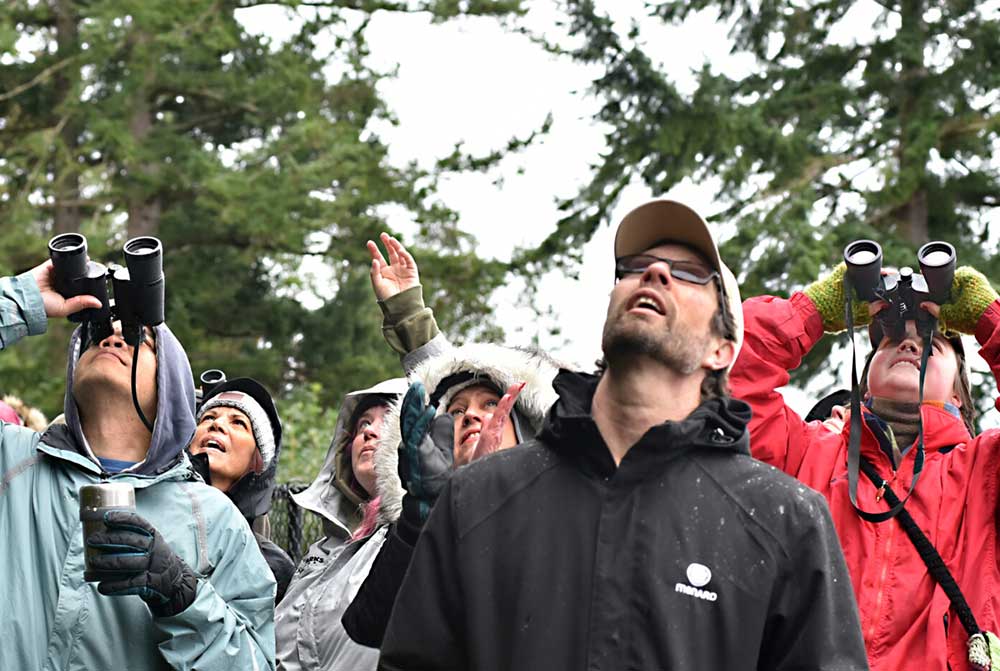
Some birds measure the health of an ecosystem simply by showing up. Pigeon Guillemots are among them. These striking black seabirds, recognized by their brilliant red feet and vivid scarlet mouth lining, spend much of the year diving beneath the Salish Sea in search of small fish before returning to rocky shorelines to nest. Sunday’s Coffee with the Birds welcomes Shannon Boldt, coordinator of the Salish Sea Guillemot Network, for a conversation about these charismatic divers and why scientists, volunteers, and beachgoers pay such close attention to where they nest, what they eat, and whether their numbers are rising or falling. After coffee, participants will head out on a guided bird walk through Titlow Park, where the shoreline offers one of Tacoma’s best opportunities to connect the morning’s conversation with the living landscape.
The Salish Sea Guillemot Network is a community science program built on the idea that ordinary people can contribute extraordinary knowledge. Volunteers monitor nesting sites throughout Puget Sound, record breeding success, document prey species carried back to chicks, and help researchers better understand changing marine conditions. Because guillemots depend on healthy forage fish populations and productive nearshore habitat, their fortunes often reflect the broader health of the Salish Sea itself. Watching one disappear beneath the water for another impossibly long dive becomes more meaningful once you understand it is quietly reporting on the condition of an entire ecosystem.
Coffee is complimentary—just bring your own thermos. Participants should wear weather-appropriate clothing, bring binoculars if possible, and be prepared to walk over uneven trails. All birding skill levels are welcome, from lifelong listers to people who simply want to learn why one small seabird with bright red feet has become an ambassador for the waters surrounding Tacoma. Sometimes conservation begins not with a grand gesture, but with noticing one bird a little more carefully than you did yesterday.
More info: Parks Tacoma Coffee with the Birds
Where the zoo proves the plants have gone wild, too
Garden Tour: Plants Gone Wild
Sunday, Aug. 2, 2026 • 10–11 a.m.
Meet at Pacific Rim Plaza, just inside the front gate
Point Defiance Zoo & Aquarium
5400 N. Pearl St., Tacoma
Free with zoo admission or membership
Point Defiance Zoo & Aquarium is full of animals, naturally, but its plants are conducting an equally ambitious international gathering just beyond the cages and aquariums. Sunday’s horticulture tour focuses on the zoo’s most exuberant tropical-looking residents: bamboo, banana plants, lush perennials, glossy evergreens, and other species capable of convincing a Northwest hillside that it has briefly relocated somewhere warmer, wetter, and considerably more dramatic. Zoo horticulturalists lead the hourlong walk, explaining which plants merely look tropical, which can genuinely thrive in Tacoma’s climate, and how careful placement, soil, shelter, and plant selection allow jungle effects to emerge beneath a sky that still knows perfectly well it lives beside Puget Sound.
The tour also reveals that the zoo’s landscape is not decorative scenery pasted around the animals. Point Defiance Zoo describes itself as a botanical garden with plants from around the world, including more than 45 varieties of temperate bamboo in the Asian Forest Sanctuary, plus native Northwest beds, succulents, pollinator gardens, semi-tropical plantings, and other collections shaped to echo the habitats surrounding the animals. Some of that greenery even becomes food or enrichment: animal-care staff harvest willow, mulberry, bananas, forest grass, bamboo shoots, and palm fronds for zoo residents, while local pollinators and nesting birds make use of the gardens for their own less-publicized programs.
Meet at Pacific Rim Plaza at 10 a.m. and arrive early enough to enter the zoo before the tour begins. The walk is included with admission or membership and is part of the zoo’s first-Sunday botanical series, which invites visitors to meet the horticulturalists responsible for maintaining a landscape that must serve people, plants, wildlife, and animal habitats all at once. Expect an easy walking tour with frequent stops, plenty of practical plant knowledge, and the pleasant realization that some of the zoo’s most interesting creatures have roots, photosynthesize, and never once complain about being overlooked.
More info: Point Defiance Zoo & Aquarium Garden Tours
Where Sunday’s souvenir is still alive
Summer Plant Sales at the Conservatory
Sunday, Aug. 2, 2026 • 10 a.m.–3 p.m. (until sold out)
Wright Park Gazebo
316 S. G St., Tacoma
Free to browse
Gardens rarely arrive all at once. They begin with one irresistible tomato plant, a fern that somehow reminds you of a favorite hike, or a flowering basket that quietly convinces you your porch has been waiting for it all along. Sunday’s Summer Plant Sale at the W.W. Seymour Botanical Conservatory fills the Wright Park gazebo with a rotating selection of houseplants, annuals, perennials, hanging baskets, specialty planters, tomatoes, and seasonal surprises, offering equal temptation to seasoned gardeners and those just discovering the quiet satisfaction of growing something with their own hands.
Every purchase helps sustain one of Tacoma’s oldest living landmarks. Since opening beneath its elegant twelve-sided glass dome in 1908, the W.W. Seymour Botanical Conservatory has introduced generations of visitors to orchids, palms, tropical foliage, succulents, seasonal blooms, and the remarkable diversity of the plant kingdom. The weekend sales extend that mission beyond the greenhouse, allowing the Conservatory’s educational work to take root on neighborhood porches, apartment balconies, kitchen windowsills, and backyard gardens throughout the city. Sometimes conservation begins not with protecting an old tree, but by inspiring someone to care for their very first plant.
The sale continues until 3 p.m. or until the plants find new homes, so earlier arrivals enjoy the widest selection. Pair your visit with a stroll beneath Wright Park’s nationally recognized collection of mature trees or a walk through the Conservatory itself, where more than a century of horticultural history still thrives beneath the glass. Whether you leave carrying a single succulent or enough greenery to make your car smell faintly of a nursery, you’ll also be helping one of Tacoma’s most cherished botanical institutions continue to grow.
More info: W.W. Seymour Botanical Conservatory Summer Plant Sales
Where Sunday begins with wildflowers and ends beneath the Milky Way
Mount Rainier National Park Ranger Programs
Sunday, Aug. 2, 2026
10 a.m. • Sunrise Ranger-Guided Hike
10 a.m. • Longmire/Cougar Rock Junior Ranger Program
11 a.m. • Paradise Plaza Program
11 a.m. & 1:30 p.m. • Sunrise Plaza Talks
2 p.m. • Paradise Ranger-Guided Walk
8:45 p.m. • Longmire/Cougar Rock Evening Program
10 p.m. • Paradise Night Skies Program, weather permitting
Included with park admission
Mount Rainier asks surprisingly little of its visitors. Slow down. Look closer. Stay longer. Sunday’s ranger programs offer nearly 12 hours to do exactly that, carrying visitors from sunlit alpine meadows to a sky filled with stars. The morning begins at Sunrise with a leisurely 90-minute ranger-guided hike through one of the park’s highest landscapes, where glaciers, volcanic ridges, marmots, wildflowers, and sweeping views remind hikers that every trail is really an introduction to a living volcano. At the same hour, younger explorers gather at Cougar Rock Campground for the Junior Ranger Program, where hands-on activities transform curiosity into stewardship and children discover that caring for a national park is one of the best adventures available.
The mountain continues the conversation throughout the afternoon. Plaza programs at Paradise and Sunrise invite visitors to pause for short ranger talks exploring glaciers, geology, wildlife, alpine ecology, Indigenous history, mountaineering, or whatever story the day’s conditions seem most eager to tell. At 2 p.m., Paradise’s Ranger-Guided Walk leaves the visitor center behind for a gentle 90-minute stroll across paved trails through one of North America’s most celebrated subalpine landscapes, revealing pollinators drifting among lupine and paintbrush, glacial streams carving volcanic rock, and tiny alpine plants racing to complete an entire growing season before snow inevitably returns. Every stop reinforces the same quiet lesson: spectacular scenery becomes even richer once you understand how it came to be.
As daylight fades, the mountain simply changes classrooms. Longmire’s evening program gathers visitors beneath towering Douglas firs and western red cedars for stories of wildlife, history, science, and the people who have long found meaning here. Then, weather permitting, Paradise hosts its Night Skies Program outside the Jackson Visitor Center, where rangers trade glaciers for galaxies and introduce visitors to constellations, planets, and the extraordinary darkness still preserved above the tree line. Bring warm layers, sturdy shoes, and perhaps a blanket or camp chair for the nighttime programs. Summer parking often fills early, so arrive well ahead of your chosen activity. Mount Rainier has spent hundreds of thousands of years refining both its landscapes and its lessons, and Sunday offers an unusually generous invitation to experience both from morning until well after sunset.
More info: Mount Rainier National Park ranger programs
Afterward at Peaks & Pints
Whether Sunday carried you along Ruston Way, into the secret lives of pigeon guillemots, through a botanical garden hiding inside a zoo, home with a new plant from Wright Park, or all the way to Mount Rainier for a day that ended beneath the stars, finish the weekend at Peaks & Pints. Choose from more than 850 thoughtfully curated beers and ciders, order a sandwich served open to close, and let one last unhurried conversation stretch the weekend just a little longer. Monday will arrive soon enough. Sunday deserves one more good pint.
LINK: The Daily Outside explained
LINK: Peaks & Pints beer and cider cooler inventory